Serving the Global Community – An interview with Bryce Wilson, class of 2011
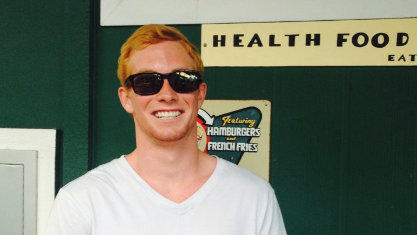
Bryce Wilson-4

Can you share a brief bio?

I’m a lifelong Waldorfian. From 3-day kindergarten to the SMWS high school class of 2011, I was granted the incredible opportunity to learn and grow in one of the most exceptional educational philosophies that our world has to offer. My family and I moved from Southern California in 2006, where I attended another Waldorf School in Orange County, to grant my sister and I the opportunity to continue our Waldorf education through the high school level. After high school, I journeyed up The Hill to attend The Leeds School of Business at the University of Colorado to pursue a degree in marketing and advertising.

You departed SMWHS to study business, advertising and marketing. How did this course of study and subsequent career change your view of the world and your place in it?

Business school taught me to see the world in a very particular and limited fashion. However, armed with my Waldorf education and unhindered curiosity, I began to incorporate the teachings I had learned in a more holistic manner and allow them to serve me along my journey rather than to limit my perspective.

What were some of the challenges you faced in entering the marketing and advertising world? And what were some of the joys and lessons?

I always knew in my heart that I was never cut out for the typical office job, and even if it was at an awesome Colorado tech company (SpotX), I needed to learn that lesson first hand. It helped develop my learned skill set in a real world setting and allowed me to become knowledgeable as to how the current world of advertising, marketing and business operates.

What drew you to engage in your current work as Marketing and Development Director  for Pride Pad? And what inspires you to work there? 

After parting ways with my office job, I knew that I would still rely on many of the skills and lessons that it taught me. I sought to continue to cultivate myself and apply my expertise in a setting that I truly believed in. Once I was ready to do so, an opportunity with an organization called Pride Pad Project practically fell into my lap. I could immediately see the tremendous value that the organization was creating in our global community. I was inspired to say the very least. The mission of Pride Pad is to provide organic sanitary pads and empowerment based education to young women and girls in Ghanaand eventually to other communities around the world that can benefit from our support. Pride Pad also strives to provide leadership skills and entrepreneurial based opportunities to such communities to further maximize our positive impact.

How has your work for Pride Pad changed your perspective on the world, and how has it affected your relationships with others in your local community and greater global community?

The work I have been doing for Pride Pad has reaffirmed that every one of us can make a difference. Be it in ourself, our local community or for those in need in countries across the worldI was reminded to never underestimate the power of the individual to cultivate love and positive action.

Do you feel that your time spent as a student at SMWS affected or influenced your current work and life choices? If so, how?

Absolutely, SMWS and the Waldorf School of Orange County both helped cultivate the person who I am today. I am a confident, curious, kind and caring individual who received the nurturing support I needed to learn and grow into the man I am today. I am forever grateful to the teachers, parents and fellow students who helped me along the way and created an incredible educational experience for me and so many other lucky Waldorfians!

What are your main objectives and goals for your work at Pride Pad?

My primary goal for my work at Pride Pad is to serve the global community. I have been so loved and nurtured throughout my life that I want to do my best to spread that love and support women and girls across the world, as well as in my local community. I am currently spreading awareness of Pride Pad and our mission and fundraising in the effort to ramp up our operations in Ghana. 

Since November 2016, we have distributed over 70,000 pads to girls in Ghana, and are partnered with the Ghanaian government to eventually ramp up production to serve the entire population and surrounding regions.  

We are actively seeking community support to help purchase additional manufacturing equipment to help ramp up operations to eventually produce 15,000,000 pads per month. 

How can people support this project?

Any contribution, no matter how big or small, makes an incredible statement about your support for not only this project, but for a better world. I ask this incredible, conscious and generous community to help in any way you can. $24 provides a young woman with enough sanitary pads to last her entire high school career! Monetary donations are very appreciated, however they are not the only way you can help. Please spread the word to any friends, family or others who you think could help in any way, It truly takes a village for an undertaking such as this. I’ve provided links to our website, Facebook, and crowdfunding sites below for additional information and contributions. I want to thank every reader in advance for your time, consideration and support for this cause! Please feel free to reach out to me at brycewilson7@gmail.com for any additional information and I will be happy to provide more details about the project, the team and our vision.

Below are additional resources for more information about Pride Pad Project:

Website:
http://www.pridepad.org/

Facebook:
https://www.facebook.com/PridePadOrg/

Go Fund Me:
https://www.gofundme.com/recfam

If you were to give high school students today any advice or words of inspiration, what might they be?

Trust your heart and listen to what it says. Do your best to find love in this world and forgive those who have yet to find it within themselves. Be truthful in every possible momentespecially with yourself. Be gentle with yourself and others along the way, when you open your heart, others will open theirs. Don’t forget to enjoy this beautiful worldit is full of love, mystery, magic and opportunity.

Bryce Wilson-5

Bryce Wilson-3

Bryce Wilson-2

Bryce Wilson-1

Choosing the Path Less Travelled: An Interview with Franceska Suarez, Class of 2015

Interviewed by Nita Davanzo
August 31, 2017

Franceska Suarez, alumna of class 2015, attended Shining Mountain Waldorf School from 3rd through 12th grade. After she graduated, Franceska took a gap year in which she traveled and performed community service. She visited the Bahamas, India, Ecuador and Europe, and then went on attend the University of Arts in London, studying fashion design. She then transferred to a school in Florence, Italy before finally coming to clarity that the study of fashion design no longer called to her. In February 2017, Franceska went to Thailand on a personal health holiday and ended up staying on at PhuketCleanse as an intern and then as a staff member. She now works as a chef in their kitchen, and develops the cookbook and online blog for PhuketCleanse. Read more

SMWS Alumni White Paper

SMWS Alumni White Paper

Dear SMWS Community,

It is with great pride that we share with you our first Alumni White Paper, entitled “A Portrait of the Shining Mountain Waldorf High School Graduate”. This article is the result of 18 months of dedicated research by Nita Davanzo, our Alumni Relations Coordinator and proud graduate of our High School. Nita conducted two surveys in addition to countless in-depth interviews with a selection of our 389 High School graduates, spanning 20 years from 1996-2016. Her research identified many distinguishing traits, capacities, and themes of our graduates, creating a profile of our students and shining the light on the power of our education in making a difference in the world. Happy reading and feel free to share this article far and wide!

Jane Zeender
School Director

whitepaper-front

Barn Swallows, Beauty, and Biology – An interview with Iris Levin, class of 2001

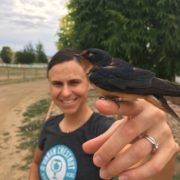
Iris and barn swallow

What initially drew you in to pursuing Biology and Environmental Studies? (was it a former teacher, a “calling”, an interest in helping the planet and human beings, the interconnectedness of all things, or “just a whim?”)

 I knew I wanted to study Biology in college, but I had my “ah ha!” moment in a class my sophomore year. The course was Behavioral Ecology and Population Biology with Nat Wheelwright at Bowdoin College. By the third week of class, I knew – I wanted to be that guy. Nat happened to study birds, and ever since my first summer of doing research with him, I’ve worked on avian systems as well. It is amazing what an influential educator can do!

You note that you have spent much time in the study of birds. Was there something in particular about birds – their ability to fly, their relationships, their mating patterns or anything else that drew you initially to study them? Had you always been interested in birds, or was this a new passion come college? 

Birds are wonderful. We know so much about them, in part because bird watching is and has been a popular hobby among scientists and non-scientists alike. Birds are abundant, they are relatively easy to study, their behavior is interesting, and they can be an excellent experimental system. I’ve been lucky to study birds in amazing places: I did my dissertation research in the Galapagos Islands, studying seabirds and their parasites. These days I study a common bird, the barn swallow, that you see swooping between cars at intersections or perching on power lines near open fields. But, why birds for me in the first place? It goes back to those influential moments in class and lab as an undergraduate. You can imagine my delight when I overheard a student this past Fall semester as she passed by my office saying “you know, I find myself really interested in birds!”. Those are the best moments in my line of work!

You currently study barn swallows with your students. Tell us a bit about barn swallows and their social behaviors. What is it about these birds that prompts the study of them? Is there anything that we as human beings can or should learn from them?

I first started studying barn swallow social behavior while I was a National Science Foundation Postdoctoral Fellow at the University of Colorado – Boulder. I was working with Rebecca Safran, who is on faculty at CU. She’s worked with barn swallows since her graduate research and we met at a ornithology conference a several years ago. Social network research was new to me, but the barn swallow is the ‘goldilocks’ bird for this sort of work; they are social, but not so social that the interactions are difficult to make sense of. Still, studying social behavior has some major challenges. What is a social interaction? How can we possibly record all of them, especially in an unbiased way? I meet this challenge by using these novel proximity loggers. The birds wear these small devices as a backpack during the time when I’m collecting data on social interactivity. The tags each emit a unique ID pulse that is recognized by other tags nearby. That way, I can collect data on every close proximity interaction between all tagged birds. From this, I can construct a social network. Then the fun part starts. After some initial work determining what physical and physiological characteristics corresponded with a “popular” barn swallow, I could experimentally manipulate these traits. For example, we know that males with darker belly feathers are preferred by females as mates. When I darkened the feathers of males and recorded how their interactions change, I found that females increased their interactions with the males who experienced this “make-over”. The coolest part? The magnitude of the shift in social interactivity was strongly correlated with the magnitude of the color change, such that males with the greatest shift in color (pale to dark) experienced the largest increase in social interactivity with females! This seems to have all sorts of simultaneous effects on physiology too, as these “made-over” males also experienced an increase in testosterone and a dampened response to stress. Folks are usually quite amused by this work and find all sorts of uncanny connections to human behavior. For me, the most exciting bit is that this is great evidence that organisms are dynamic, interconnected, and integrated systems.

You are a tenure track professor at an all women’s college (congratulations!). You also taught at Grinnell and CU Boulder. Did you choose to specifically pursue teaching at an all women’s school? If so, why? What are some of the benefits and / or challenges that you see in teaching at an all women’s school vs a co-ed institution, and what might you see as some of the benefits and / or challenges for your female students?

[I actually didn’t teach at CU, I was just doing research].

I love my job at Agnes Scott! I didn’t specifically seek out a position at a women’s college, but I am very happy to have a position at one! It’s difficult to get a tenure track job anywhere, and I was very lucky to have several options last year. Agnes Scott was by far my favorite among the job offers I had in hand at the time.  I had enjoyed my campus interview a lot, especially the time I had with students. There is definitely something different about my classrooms now compared to co-ed classes I have taught at Grinnell and the University of Missouri – St. Louis. I actually have a hard time putting my finger on exactly what it is that’s different! One thing for sure is that I tend to get more even participation from a larger proportion of students than I am used to in co-ed classes. And these women are highly motivated to learn, which is a joy for me. I’m also very lucky to teach at an institution that has a fabulous commitment to diversity. Our student body has no ethnic majority, we support a large number of first-generation college students, as well as students from modest economic backgrounds.

As a female scientist, have you experienced any difficulties in making progress for your self or your work in the field? Do you feel that science is on a more inclusive trajectory, regardless of gender? And have you seen a shift in the years since you were student up to now in terms of gender equality in the field?

I recognize moments in my career where I experienced sexism, but to be honest, I am more aware of those moments now than I was at the time (perhaps because I’m at an women’s college!). Women are now the majority of undergraduate biology majors, we’re getting PhDs in my field at a high rate, and are well represented at the postdoc stage. There are still fewer women in tenured and tenure-track positions in biology, but that’s hopefully changing too. To succeed in academia one needs to be all in. I pretty much live and breathe my science. This is possible in part because my better half is also a biologist! I’ve had some absolutely terrific female mentors who have shown me that it is possible to achieve one’s goals as a scientist while still living a balanced life. Now, I’m so excited to get to be a role model for my own students in this way.

How do you feel that your Waldorf education served you in pursuing the sciences and your chosen teaching profession? [can you call this academic profession? So often, folks interpret a faculty position at a liberal arts college as just teaching when in fact we are (mostly) active in research too!]

 I’m 100% sure that my Waldorf education (I’m a lifer!) made me the creative scientist that I am today. Science is truly a creative endeavor; the best science makes new and exciting connections between existing bodies of knowledge, asks new questions, and looks at old questions in new ways. Writing is also critical to good science. Science students don’t often realize this, but as professionals, we write a lot. Our ability to secure funding depends on clear, persuasive grant writing and we disseminate our findings in scientific journals. I learned to love to write as a Waldorf student and this has served me well in college, graduate school, and beyond.

As a biologist, I imagine that you see the world through a slightly different lens than the average person. Can you describe this lens? (This may be hard question- because you have never looked through any other lens other than your own!) 🙂

 Biologists are curious about the natural world. By that definition, I’d hope we are all biologists! Unfortunately, we are often too busy on our phones to notice the world around us. It’s a real shame, because we miss a lot. If we don’t know the world around us, we’re far less likely to care about it. We’ll never protect something we don’t care passionately about. So the next time you’re walking outside, try generating five questions about the life around you.

You work with young adults on a daily basis. What words of wisdom and inspiration do you seek to give to them? And what inspiration on a daily basis do they in turn give to you?

I think that one of my favorite parts of being a college professor is watching my students figure out what they don’t know. As a high school student you get pretty good at knowing what you know, but it is typically in college that you start figuring out just how much you don’t know! This is critical for me as a teacher/scholar because then I get to push my students to do something with what they don’t know. How would we figure this out? What’s the next step? That’s not really about words of wisdom though. I think the most important thing I find myself saying to students when I’m advising them about careers is that they should do what they love, not what they think they should do or what their parents think they ought to do. You’ll be so much more successful (however you wish to define that) doing something you’re crazy passionate about! My students regularly inspire me with their willingness to try (and sometimes fail). Teaching is a two way street and the best moments come when students are engaged in learning, and that involves being wrong.

Iris Agnes Scott students and bluebird


Living Positive Action in a World of Change – Interview with Jordan Chase Jacobsen, class of 2001

IMG_0100

Can you give us a brief overview of what transpired in your life post-SMWS?

After graduating from SMWS in 2001, I attended Connecticut College, which has fantastic international opportunities that allowed me to study and intern for United Nations organizations in both Vietnam and Germany.  After graduating, I moved to Washington, D.C., where I worked at the Federal Trade Commission (2005-07) and then the Central Intelligence Agency (2007-2012).  While continuing to work at the CIA, I went back to school for a law degree at Georgetown starting in 2011, and interned in the part of Obama’s White House focused on science and technology.  Since receiving my J.D. from Georgetown in 2014, I have been practicing law at the international law firm Gibson, Dunn & Crutcher LLP.

What led you to study International Relations at Connecticut College, and what prompted you to continue your studies at Georgetown?

On September 11, 2001, I was a college freshman in my first weeks of classes when hijacked planes slammed into the World Trade Center and the Pentagon.  In retrospect, although my family and I were physically unharmed by the attack, I think 9/11 had a profound impact on my choice of studies and career.  As for many Americans, 9/11 instilled a fear for my personal security that I had not previously felt, but it also ignited an intense motivation to learn more about the world and others.  I redoubled my efforts to learn foreign languages, live overseas, and understand the socioeconomic root causes of terrorism.  This is what led me to study and write an honors thesis in International Relations.  This is also what led me to work at the CIA.  I owe a lot of credit to SMWS for providing me with the tools to respond to 9/11 in this way.  SMWS instilled in me a love of learning and a desire to seek greater understanding and empathy at a time when many were recoiling in fear. 

What were some of the highlights and challenges about practicing law during this time in US history?

This is a fascinating time to be practicing law!  In my opinion, it has never been more important than it is today to use legal tools to protect free speech, equal protection, press and religious freedoms, and antidiscrimination laws! My law firm has been front and center in responding to President Trump’s unconstitutional and, frankly, un-American immigration crackdown.  But there are also many less newsy ways in which lawyers are helping.  For example, last year, I helped a woman from Afghanistan attain refugee status and served as pro-bono guardian ad litem representing two children in a child custody dispute in the District of Columbia.

Similarly, what were some of the challenges and highlights of working as an analyst at the CIA, writing assessments for the Presidential Daily Brief?

Keeping it short!  Especially when writing for the President and other Cabinet-level policymakers, I found that the greatest challenge was communicating complex information concisely.

More generally, analysts at the CIA face the challenge of deciphering meaning from an overwhelming volume of incomplete and often-contradictory data, both classified and public. I think SMWS prepared me particularly well for these challenges because it instilled in me an incredible appetite for learning.  I also think my education gave me the ability to communicate ambiguity and complexity where others might seek categorical black-and-white answers. 

What were some of the underlying reasons prompting your return to Boulder, away from DC?

In short, we moved back to be closer to family and to give our children the opportunity to grow up in this wonderful place.  We decided to move back to Boulder when my wife was pregnant with our second child.  Now we are just a short walk or drive from my parents, and my oldest son is already attending Boulder Waldorf Kindergarten. 

If you could choose to take on only a certain kind of case and / or client, what and who would that be?

Actually, one of the aspects of practicing law at Gibson Dunn that I like best is the breadth of clients and issues.  I have had the opportunity to defend a small startup developing cancer-fighting immunotherapy drugs, draft appellate briefs on behalf of the largest freight railway in North America, research First Amendment protections for commercial speech in a food labeling case, and help defend immigrants from deportation.  However, to attempt to answer your question, I think if I had to pick one client or area of practice, I would try to choose an innovative company in the renewable energy field because I believe that climate change presents the single greatest long-term challenge to our civilization.

What advice would you give to a young adult (and to us all!) growing up in this turbulent and charged political environment?

I think the best response to the current political environment is to seek truth and empathy for others.    My two year old has entered the age of asking “why” all the time.  It has been a wonderful reminder to me to try to look past the latest headline or tweet and to try to understand the underlying motivations or fears of those with whom I disagree.  We live during an incredible age of information, but there is also a lot of disinformation out there.  I think we need to continue the age-old search for truth.

You have 2 little ones now. What’s the most important value that you as a dad would wish to share with them, and why?

Gratitude is the value that I wish to share with my sons.  I think it is often difficult for us to acknowledge all the help we have received along our journeys.  Perhaps we think that it would diminish our own accomplishments.  But I certainly would not be where I am today without the assistance of such wonderful parents, teachers, and friends, not to mention the unprecedented levels of peace, prosperity and civil liberties that our generation has enjoyed and so often takes for granted.  I think just drawing attention to the privilege that we enjoy helps us to live better lives.

image2

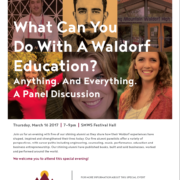
SMWS Alumni Panel | Thursday, March 16, 7-9pm

What Can You Do With A Waldorf Education? Anything. And Everything.

Please join us for a special evening with some of our treasured Shining Mountain alumni and learn how Waldorf education and their time at SMWS have impacted their life paths and what wonderful things they are doing now in their lives!

Event: SMWS Alumni Panel

When: Thursday, March 16 | 7-9pm

Where: SMWS Festival Hall, 999 Violet Ave, Boulder

alum-panel2017

An interview with Gelsey Malferrari, class of 2001

Interviewed by SMWS alumna & current Alumni Coordinator, Nita DaVanzo

From your time of graduation from SMWS in 2001 to now, where have your steps taken you? 

Down some expected and some very unexpected paths. I started my college career at Earlham College in Richmond, Indiana. After a year of academics I was invited on a 3-month world music tour of the US with a wonderful group of singers called Northern Harmony. We went coast-to-coast singing music, from old American shape note, to music from South Africa and everywhere in between. This semester away from college gave me some perspective on my life and I soon transferred to Warren Wilson College in North Carolina where my passions were sparked and my soul was fed. After graduating in 2006 with a BA in Integrative Studies (the major of choice for those of us that love too many things) I found myself on a plane to Europe where I traveled solo for 4 months, only to return for a few weeks and get on another plane to hitchhike my away down Central and South America with my future husband, Neal Ritter. We had $2000 and a return flight out of Brazil 4 months later. Needless to say we are still telling the many stories of our adventures, but best of all is that that trip was the birthplace of our thriving non-profit organization: Laughing Coyote Project. Our dream was to create a program for youth in our area that would encourage them to connect more closely to the earth through primitive and ancestral skills.

Neal and I are now a family of four. We have a three-year-old son Lutreo, and a four-month-old daughter Fianna. We live about 5 minutes from the house where I grew up, on Nelson Rd and live and work the land around our house trying to grow all our own food (vegetables, grains, and livestock) raise our children, enrich the land, run our programs and live more lightly. 

What initially inspired you to begin pursuing your current work as educator of primitive skills and founder / owner of Laughing Coyote Project, a Primitive Skills School?

When Neal and I were traveling, many of our conversations kept coming back to the same themes: our education (what worked and what didn’t); living more lightly on the earth; craving more outdoor time in school; and wanting to understand more deeply the ways of our ancestors. I have always loved art, but buying art supplies was expensive and I kept asking myself: before one could just go into a store and by watercolors and brushes, what did people do? They made their own… but how? So at Warren Wilson I started designing classes for myself that encouraged me to go deeper. I learned to make different colored pigments from the earth all around the College; I learned to make binders (so the pigment would not rub off the paper) from eggs, milks, and glues. At the time I did not realize it, but I was well on my way to teaching myself primitive and ancestral skills. So when Neal and I met and started sharing our passions with each other, we realized that we were both obsessed with learning the skills of our ancestors and teaching and being our own masters. And thus our school was born. Over the past 10 years Laughing Coyote has evolved immensely, so today we work with youth, teens, adults and families. We participate in our landscape, dive deeply into the rhythms of the natural world and follow the living skills left by ancestral peoples. We play games, run and hide. We use tools of steel, antler, wood and stone. We track the wild animals that infuse our surroundings. We seek a lifeway that embraces the future while honoring the past, to serve as stewards for future generations.  We believe that community is grown slowly and organically through simple authentic human interactions. We hunt, forage, garden, compost, build structures, and run barefoot.

How has the Laughing Coyote Project developed over the years since its creation, and what are the joys and challenges of this work for you as individual and in the greater context of the world today?

The first day of Laughing Coyote Project started in the Fall of 2007 with five homeschool students. We now enroll about 40 students for our yearlong homeschool programs for both youth and teens, and have about 120 students that move through our vibrant summer camps and an eclectic workshop schedule. To be quite honest, we have been flying by the seat of our pants since day one. Neither of us took any business classes, I took a couple of education classes in college, but that is really the extent of it. We had a vision and we started making it happen. Student by student, day by day, year by year.  Basically we are learning as we go and we would have it no other way. We absolutely LOVE what we do. We live and breathe Laughing Coyote and barely an hour passes in each day that Laughing Coyote is not mentioned. I would say that this is both joy and challenge, as sometime we get lost in this thriving, rolling story. Sometimes it feels like we are working 4 full time jobs: the administrative side, the teaching side, the farming side, and the family side. This is the life we have created for ourselves and it is a full one. The way I answer this question depends on the day you catch me. Today, things are looking up, but tomorrow, the overwhelm might be too much to bear. Bringing two young children into this vision has also been an interesting change, as I am now teaching less and spending more time raising our children. In the last year we have hired a full time instructor to teach alongside Neal and it has been an amazing experience to convey all that we do and how we do it and why we do it. It has helped us think more deeply and gain a better understanding of our constantly evolving vision.

Why do you feel the work that you do is essential and vital to the world today? (you may have already answered this in the first question! I am hoping to hear from you how and why you feel what you are teaching is of value and NEED in the world today! I certainly think it is vital learning – but would love to hear in your words why this may be so…)

“The Earth is our Mother, we must take care of her…” The best way to establish a relationship with anything, especially the earth that we live on, is to spend time with it, her. Over the years we have developed programs that facilitate a simple way to connect to the earth. We play games, running along the landscape, sliding down muddy banks, getting jabbed by Russian Olive thorns.  We remember the skills of our ancestors: gathering willow along the pond to weave baskets, learning to start a fire so that we can keep ourselves warm, coal burning a spoon or a bowl. We are out in all weather, the only indoor space we have is a tipi, so the experience of the changing seasons is full on. This is the way Neal and I wish that we could have been educated, and so this is the way that we are trying to educate future generations. We want them to be at ease when they are outside, feel the freedom of being self-sufficient, trust their instincts, rely on their peer group, and find joy in remembering the past. Our world is moving so quickly and more and more time is spent indoors staring at a screen, whether it is a phone screen, computer screen, TV screen, it doesn’t matter. We all need to spend more time doing and less time observing others doing. We offer an antidote to the speed of the current state of the world. We are about living deeply engaged in our surroundings. For example, new students that join us usually learn make a fire within the first couple of weeks that they are out here. We start them in the present, they quickly master the match, then they learn the intricacies of flint and steel, and blowing a tinder bundle into flame; soon after that they learn the excruciatingly difficult skill of friction fire, many of our students spend years working on this. But it never gets old, because it is alive, they are working with living materials that are always changing, and their mood effect the outcome, the weather effects the materials. We are slowing everything down and empowering each person who steps foot on our land to allow themselves to be swept away by the power of nature and ancestral skills. For some that pass through Laughing Coyote, this way of living is interesting and may give them deeper perspective or assist them later it life, but it stops there. For others this opens up a whole new outlook on the world and changes their life forever. As educators both make us deeply happy.

You are a mama now! As you raise your children, what are some of your core values that you wish to share with them. 

In our household this is a continuous conversation and it seems to change from day to day as we watch our children grow and change, and as our lives evolve and grow. I would say that currently we are working on very simple core values, which in the future we hope our children and our family will be able to live more elaborately. One of the most important things to both Neal and me that we feel quite strongly about is understanding where our food comes from. This is why at the dinner table our son Lutreo will often ask: “Mamma, are these carrots from our garden? Who gave us these potatoes? Is this bacon from Jamie’s pigs?” It is a continuous discussion about where things came from and what kind of animal it is from. “Is this meat from a steer or a bull?” We would have it no other way. We want our children to be asking these questions, to know the name of each famer, to plant the seeds in the garden, water them, weed them, watch them grow, harvest them and then eat them. Another wonderful quote: “Jake, thank you for this delicious sweet milk.” To us this is the best way to deeply understand the earth and all that she provides for us. We look forward to the day that our farm will provide us with almost everything that we need so that our children can directly be involved in the process. We also believe that children should be outside. So, that is what we do, we spend a lot of time outside with the kids, whether it is taking the goats on walks around the land, doing farm chores, hunting, foraging in the wilderness, splashing in our pond, putzing and working on a project. All weather, hot, cold, windy, wet, no matter what we are out there teaching our children that it is normal and if you are a little uncomfortable it is all going to be OK and we look forward to the days when our children can experience timeless hours of freedom, creativity, and exploration. 

How do you think your education at SMWS shaped your current work and lifestyle today?

There is no doubt Shining Mountain influenced my life, as I spent thirteen of my 33 years playing in the playground, walking the pathways, and sitting in each classroom. The art, music, peer cohesiveness, questioning, wonder are all things I continue pursue and deeply appreciate in my adult life. I would say that though I had a bit of a rough ride in high school, the richness of the Waldorf education supported me in staying engaged. So, through questioning and pushing against the only educational system I had experienced I started to forge my own path and wind my way around to where I am today.
gelsey1

20 years ago, did you have any idea that you would be where you are today? If you could, what would you tell your high school self today?

I would probably say: The high school years are some of the most self absorbed years of your life. Make sure to not lose perspective. Do something meaningful for someone or an organization in the greater community, regularly, so that you remember how small you are in the scheme of things, but also how important each helping hand can be. It is impossible to not get caught up in peer pressure and peer group socializing, but make sure it is not all consuming. Balance it out by pursing things that inspire you, so that you don’t completely lose yourself. Don’t ever let anyone tell you that you cannot do something, or that something cannot be done. That doesn’t mean close them out. Always listen to what others have to say and weigh all the different opinions, but be sure that you are not disregarding your heart and what you believe is true for you. Last of all, you never know what life is going to throw at you, so practice living each day fully and just make the best decisions that you can, because you can always change course and things usually have a way of working themselves out.


Connecting People to the Planet – An interview with Calla Rose Ostrander, class of 2000

Environmental Leader and Climate Change Activist

calla-ostrander

Since your graduation from SMWS in 2000, down what paths has your heart led you (college, grad school, work, adventure, and more!) (Can you include your current job title and where you work?)

It is so wonderful to be asked a question, a first question at that, about heart! I find again and again that the heart is the leader. My heart lead me to my work in this world, reconnecting people to our planet with wonder and beauty. But my career path formed when I first understood the concept of economics. In addition to being a product of thirteen years at Shining Mountain Waldorf School, I came of age in the 1990’s Clinton era of a rapidly growing and globalizing free market. Economics was the language of power and in 8th grade at a green living fair on campus I read a book by Paul Hawken and Amory and Hunter Lovins that became my first bridge between my love for the web of life in which we all live to the economic structures of the modern culture which we agree to all live by. The summer after I actually went to Snowmass Colorado, where the Lovin’s non-profit Rocky Mountain Institute is located, and asked if I could intern with that summer. My mom drove me up (thanks mom!) and I took the bus in. Though I was very serious in my inquiry about an application to intern, the lady at the front desk all but rolled her eyes at me. She told me that their interns all had college degrees. I said I’d pull weeds for free, she said the people who did that had masters degrees. Another, kinder, woman with ginger colored curly hair drove me back to town and told me to go to college and come back.I attended the University of Puget Sound with the help of family, friends, many part time jobs and a classical music scholarship. I returned to Rocky Mountain Institute the fall after my graduation with a degree in International Political Economy and the same woman who gave me a ride home became my mentor. At UPS (not the brown box one) I gained a deeper understanding of the social, political and economic structures that surround environmental policy and identified cities as the place where real political action towards climate change was beginning.  I worked with cities as part of my role at RMI and when I was offered a job to help the City of Aspen write its first climate action plan I took it. After three years in Aspen’s global warming office I decided I needed to learn Spanish (and how to surf) and left for Mexico. However, through a series of wonderful circumstances that involved six months of travel gear and my passport being stolen (less wonderful but ultimately important), falling in love, and being recruited by a very persuasive human being, I ended up working for the City and County of San Francisco implementing then Mayor Gavin Newsom’s climate policies and program for the next six years.In 2013, celebrating the completion of San Francisco’s new Climate Strategy (which, in case you are curious, boils down to three numbers and one word: 0, 50, 100, Roots), and in pursuit of solace for a broken heart, I went on a surf trip up California’s northern coast.  On our second to last day at sunset when glare was high on the water, I dove off my board into very shallow water and suffered a moderate traumatic brain injury.  Healing my head and my heart led me to a new way of approaching the world. I am grateful every day for the incredible gifts of a working body and mind and for this amazing capacity in life that we call resilience.I am now an independent strategic advisor to individuals and organizations committed to stabilizing the Earth’s climate and I love my job.

Did you always envision yourself stepping into working with / for the environment? When were you first inspired to take this work on?

The best answer I have for this question is “yes”. From the first time I began to formulate what I would do in the world, it was always this. When I was young we took a trip to Costa Rica. The rainforest was magic to me. I can still remember seeing the toucans fly, big wide swooping dives. Having only seen this creature in a cage before, it was like seeing freedom and joy and power all together – my heart soared with it. Then we saw the clear cut: the stumps of trees like butchered limbs, the broken skin of the earth, soils washing down the roads. The people we stayed with took in monkeys that no longer had homes, took in neighbors who no longer had homes. My heart broke for all of them, the trees, the animals and the people. I internalized it. Every night before bed from 3rd grade through what must have been 7th grade I prayed that one day I might help save the rainforest. I think I also prayed to marry Macaulay Culkin or Evan Silverman.Thank goodness the universe is wise enough to not answer all the prayers in an exact fashion.

Do you feel that your SMWS education and curriculum supported / inspired / prompted you to dive into the waters you find yourself in today? How so or how not?

Yes, absolutely. And there have been challenges, like not knowing how to type quickly or properly cite academic text when I went to college. I still can’t spell and I write in run on sentences. But there is spell check and things like citations can be learned in a semester or two. What takes longer to learn and what I am increasingly grateful for my Waldorf education is three fold: the ability to observe a full system and parts of any system simultaneously, the self authority to think outside the box, and the combined ability and desire to communicate across a wide diversity of people without prejudice who may be inside many different boxes (long years sitting in circles working things out, ropes courses, plays, etc). Perhaps equally as important, Waldorf gifted me with a second family for life in my classmates. 

What does a typical day for you look and feel like?

I spent nine years working in an office 9am-6pm and commuting to and from. Then, because of my injury I had an opportunity (/was forced) to be off of screens and out of the office for almost a year. In that time I realized I’d lost track of bird song and the way the air smelled. I now try and start each day with enough sleep and a walk outside. I work across the state of California or from my living room in Topanga when I am not traveling. I know the birds in my neighborhood and the people and their dogs and the coyotes too. 

Who are the people that inspire you in your work the most?

I have been inspired by so many incredible people, Barbara Rose Balock, Amory Lovins, Randy Udall, Silvia Earl, Arnie Ostrander, and the people who’s names who haven’t heard but who make entire cities and water systems run. Two years ago I left my position with San Francisco to join a team of people who started something called The Marin Carbon Project. This includes folks from the Resource Conservation Districts (best kept secret in conservation) co-founder John Wick and his wife Peggy Rathmann, Dr Jeffery Creek of the Carbon Cycle Institute, Dr. Whendee Silver of UC Berkeley, Rebecca Burgess of Fibershed, Dr. Nuna Teal of The Jena & Michael King Foundation, and my friends at 11th Hour, The Berry Good Found Foundation and Kiss the Ground. These people are in the process of starting the second agricultural revolution and healing our relationship to the planet in the process. It is my joy, honor and daily inspiration to work with them all.

 How do you get people who may be uninterested in supporting the environment to listen, change their views, and / or become conscious about their possible harmful actions?

I was given the amazing fortune of being able to ask this question of His Holiness the Dali Lama. He answered saying he believed most human beings are innately good and want to do the right thing. And that all change begins with you: your body, your home, your neighborhood, your community. His answer was of course longer and dazzlingly beautiful, completely circular, and left me high for days. But that is essentially what I took away from it, and that is always where I start with anyone I am speaking to about my work. I start by trusting them. Then taking time to understand where they come from, what they care about and what they do every day. This allows me to understand what they value and what their goals are. Once I know that I share with them my values and goals and we can see what we have in common, then we have a place to begin.I’ve also found that having the best data and telling good stories is far more powerful than trying to raise someone’s consciousness by pointing out what they are doing is wrong or using fear or shame. The environmental movement has too long relied on this kind of messaging and people are tired from it. Fear and shame may work on an immediate basis, but people are burnt out by it and it requires a lot of intense energy to keep up (Fox News). In the long run it just makes people angry (current presidential election). Inspiring love, or teaching someone something new is much more powerful. Those seeds stay with people and bloom into solutions you could have never come up with on your own.

Do you see / feel a difference in working with older vs. younger generations?

I once worked through the same problem of how to best manage restroom paper towel waste with a group of Waldorf 6th grade girls and with the city council. It took the Waldorf 6th graders two hours, while it took me three months with the a city council! Young people’s minds are more open, and so are their emotional bodies. They don’t have as many experiences that would evoke fear or political loyalty or ego that adults often do and that allows them to take risks by committing to an idea, following it through and then leaving it quickly when it fails, then repeating this until they find the answer that works. That being said, I believe it is essential that the adults stop placing the burden of action upon the younger generation and take responsibility for what is in front of us now.

If you could change the world for the better today, what would you do?

Teach people how to engage consciously with their fear of death and install composting everywhere. 

For young adults coming into the world and searching for inspiration, for meaning for ways to help, what guidance and advice might you give them?

Follow your heart, it is the leader. Use your mind to figure out how to get there. Learn to listen to your gut, it knows when and what decision to make. Time is yours.

Is there literature or periodicals that you feel all young adults and adults should be reading in order to stay informed about environmental change?

National Geographic and Scientific American are great for learning how natural systems work and falling in wonder with the beauty of the world. I subscribe to the journals Science and Nature Climate Change. Online, NASA and BBC have great resources. Grist is great and easily digestible. I also have a Google search that delivers articles related to topics I want to follow. I don’t read them, but I open the emails to scan headlines, it helps me keep tabs on the conversations in the media.

What is your favorite quote? OR what is one of your favorite memories from SMWS?

…the moment one definitely commits oneself, then Providence moves too. All sorts of things occur to help one that would never otherwise have occurred. A whole stream of events issues from the decision, raising in one’s favor all manner of unforeseen incidents and meetings and material assistance, which no man could have dreamed would have come his way.Whatever you can do, or dream you can do, begin it. Boldness has genius, power, and magic in it. -Goethe