Principles for Regenerative Agriculture: Nurturing a New Partnership with Nature

Principles for Regenerative Agriculture: Nurturing a New Partnership with Nature
with Beth & Nathan Corymb, Cristina Geck, Cameron Genter, Daphne Kinsley, Kirk Mills and Dennis Stenson

Shining Mountain Waldorf School and the Biodynamic Association are bringing together six experienced Biodynamic farmer educators from our region for sessions on the inner development of the farmer, Biodynamic perspectives on the co-evolution between earth and humanity, and innovative principles to nurture a new partnership with nature. October 9-11, 2015.

Click here for more information

biodynamic

“What is Michaelmas” By David Blair (1952 – 2013) Beloved Faculty Member

davidblairOne of our traditions borrowed from Waldorf schools in Europe is the celebration of
 the Festival of St. Michael, or Michaelmas. The legendary origin of the holiday, which accompanies lengthening nights and the cold of autumn, is the victory of St. Michael, patron saint of mariners and horses, over the powers of darkness, symbolized by the evil dragon. Folklore in England holds that the devilish dragon landed in bramble bushes, and that one should not pick blackberries after Michaelmas!

In our school we look to the Michaelmas festival to stir teachers to inspire the students with stories both old and new of human courage and initiative. We do not have to look far to see that the world is crying out for new ways of thinking and living, new forms for working and for social life, and for leadership, political and otherwise. The world is transforming around us at tremendous speed and, as bold as those in the forefront of change can be, often more boldness is demonstrated by the tenacity with which the old dying world tries to hold on and resist the new at all costs. michaelmas-painting

The Michaelmas festival reminds us to honor the courage that we see
 around us every day in noble acts, large and small. The courage to stand up for someone who struggles, or to look for the good in others, or to strive for something more.

As teachers we recognize the Michaelic courage of the Shining Mountain parents who have stood up against the old dying forms of education and chosen a schooling of the future, one that seeks to awaken the true, radiant individual in each of our students, nurturing that vision into reality. We also recognize it in each other and are grateful to have such colleagues, who could have chosen other work for themselves but have dedicated themselves to a future which honors that which is human in each of us. And we are grateful for the Michaelic students who enter our school each year, having chosen it in the depths of their souls, and those that graduate, determined to shine their particular lights of courage into the darkness of a troubled, trembling world.

Michaelmas is more than a date, more than a season. It is an urgent force, calling forth our deepest energies to seek out that which is good and true in
 all of us, and encouraging it to grow and flourish. Just as nature only appears to be dying but will return again in spring, so will deeds of courage, large and small, only seem to be insignificant or fleeting, but will surely help to launch a bold new world which yearns to emerge and shine.

By David Blair (1952 – 2013) Beloved Faculty Member

Shining Mountain Awarded Green Star Business Rating

Eco-Cycle-GSB-Ad-July-2015_Daily-Camera-Ad-8-6-15Shining Mountain Waldorf the First Private School in Boulder to Be Awarded Green Star Business Rating

A prominent national environmental group has recognized Shining Mountain Waldorf School as the first private school in Boulder to be awarded its Green Star Business rating.

Eco-Cycle, Inc., a large Boulder-based nonprofit that has also been offered curbside recycling in Boulder County for the past 30 years, announced Shining Mountain as one of eight area businesses currently holding Green Star Business rating Friday in a large ad in the Daily Camera, a daily newspaper in Boulder. Shining Mountain Waldorf School has held the distinction of a Green Star rating since 2011, when it originally received Green Star status through Eco-Cycle—the first private school in Boulder to achieve Green Star rating.

The non-profit environmental group, long recognized as an innovator in resource conservation, also awarded eight other Boulder-based businesses with its coveted “Green Star Business” rating including Ocean First, Bhakti Chai, Boulder Brands, Boulder Housing Partners, DOJO4, Vermilion, SanDisk and SparkFun Electronics.

The Green Star Business (GSB) program commits to a sustainable cycle of zero waste, where “there is no such thing as ‘waste’ because materials are kept in the production cycle.” In the case of Shining Mountain, students are already accustomed to composting their food waste or donating it to the school’s chickens.

Elizabeth Plumb, a GSB specialist at Eco-Cycle, congratulated Shining Mountain on the coveted Green Star Business rating.

“The school has a sustainable lunch container program and purchases 100 percent recycled-content, non-toxic, local products from vendors that promote sustainability at every opportunity,” reads a release on the Eco-Cycle website. “Committed to environmental stewardship and a member of Eco-Cycle’s Green Star Schools program, locally run Shining Mountain Waldorf School is increasing their already-stellar sustainability efforts.”

Mary Eaton Fairfield, Director of Admissions and Marketing at Shining Mountain Waldorf School, said the school was very pleased to be recognized as the only Boulder private school to be granted Green Star Business status, “Environmentalism is in line with the school’s curriculum and emphasis on learning through nature.”

“It is important for us as educators to be an example in the world and to the students we teach about the critical importance of the care and guardianship of our planet,” Fairfield said. “We want to keep developing a strong network of like-minded businesses through the Eco-Cycle program, thus increasing our sustainability outreach not only in the school community, but in the greater Boulder community, as well.”

Fairfield said being a part of the Eco-Cycle Green Star Business program means having a partner in the community to help the school gain new, innovative sustainable building ideas.

Waldorf Education and the Use of Technology by Vicki Larson

imgresAccording to the Kaiser Foundation, children and youth use four to five times the recommended amount of technology, with serious and often life-threatening consequences. Electronic technology and media have the power to take us outside our bodies and outside time: they mesmerize and often addict us, and by their very nature – think of the word media – they mediate our experience of the physical world.

Because of its stance on technology and electronic media, Waldorf education is consistently garnering attention. Since a primary goal of Waldorf education is to ground students in their bodies, in three-dimensional space and in human interaction, the schools aim to offer students unmediated experiences. But what exactly is Waldorf education and how does it educate students in the use of technology?

Technology is a creative interaction with the world. The Greek word techne means “making,” “craft” or “art.” For the Greeks, there was an art of speaking, an art of doing. Art is the technique of doing things well. Technology, the study of techniques, is integral to Waldorf education. Students are taught to interact in creative and innovative ways with the world they meet.

In order to fully understand how Waldorf schools approach the use of technology, it is important to know that they define “technology” broadly (as a way of interacting with the world), rather than narrowly (as mere devices and software).

The Essence of Waldorf Education

The Waldorf philosophy on technology is based on a developmentally appropriate curriculum, founded on the understanding that every child goes through three distinct phases of development: infancy and early childhood (birth to 7); middle childhood (7 to 14); and adolescence (14 to 21). Each stage requires a different approach. By facilitating self-initiated exploration and learning through play and imitation during early childhood, engaging the imaginative nature of the child in the lower school and delivering a curriculum that answers a different life question each year in the high school, Waldorf schools strive to meet students right where they are in their development. Some Waldorf teachers use the metaphor of a rubber band stretched tightly, slingshot-style. By holding back on introducing material until a student is ready (pulling the rubber band tighter), a teacher enables a student’s imagination to fly further once it is offered.

This rubber band metaphor is especially apt in relation to the way that Waldorf schools introduce technology to students. It is not until middle school that students begin to engage in Internet research and computer science. Even in high school there are no Smartboards or iPads in Waldorf classrooms, out of a belief that these devices can create distraction and dependency, and can take away from a student’s ability to develop the capacities to calculate, analyze, and connect with others.

Waldorf schools prioritize engagement (the human interaction between teachers and students and between peers) in the classroom, and the social skills that come with it: making eye contact; learning to listen; developing flexibility of thought and the ability to see another person’s perspective; and working together in a group to solve problems or understand a difficult concept.

Early Childhood: Doing

As a foundation for healthy development, children must have trust in the world. From birth to age seven, the aim of the Waldorf teacher is to surround students with beauty, truth and goodness. The teacher strives to be a model worthy of imitation, and to share all that is good in the world with the students. He or she also focuses on providing an environment that enables the children to develop healthy bodies and wills, engaging their natural desire to move and explore, to do.

At this stage, a key goal is learning to see how the world works. Technology is understood as learning how to have an impact on how things work: moving a stone from one place to another when it’s too heavy to lift, creating a lever or a pulley from a piece of wood, pouring water so that it goes where one wants it to go. In early childhood, technology means understanding and mastering one’s physical body and its interactions with the world.

Middle Childhood: Feeling

From ages 7 to 14, the child’s feeling is engaged through stories and the direct, unmediated relationship with the class teacher, who loops with the class for several years. Each morning in main lesson, children are told stories related to the block, a period of intensive study on one subject, they are studying; students are taught in blocks from grades 1-12.

In the early years of the Lower School, when connecting students to their studies through their feelings is paramount, there is no electronic technology in the classroom. But the concept of techne lives strongly: teachers are instructing students in the art of doing things well. A hallmark of the Waldorf pedagogy is that all subjects are taught artistically, developing the corpus callosum, which connects the left and right hemispheres of the brain and facilitates communication between the two hemispheres.

This means that, in grade 1, children learn to write by first seeing the letters of the alphabet as images: a king with arms outstretched forms the letter K; a mountain makes the letter M. The students then practice drawing these characters. From there, they learn to string the letters together into words, and then to read.

In grade 3, during their study of house building, they build models of houses that have been constructed throughout time and across the globe. In grade 5 geography, they create detailed maps that help them orient themselves in space. In grade 8, as they study geometry, they sculpt geometric forms in clay to help them see and feel the forms in three dimensions, making an abstract concept tangible.

These physical experiences of drawing letters, building houses, and sculpting complex forms develop different neural pathways than would be developed by looking at letters on an electronic device or researching the history of architecture or geometry on the Internet. Electronic technology and media do not enter students’ lives until about age 11, when computer science and Internet research skills are introduced in middle school. Waldorf schools believe that students are ready to engage with electronic media only after they have spent several years living in the world in three dimensions, and developing mastery over their bodies and their wills.

Adolescence: Thinking

The strengthening of the intellect and critical thinking are key areas of focus in the adolescent years. Until Waldorf high school students graduate at age 18 or 19, their teachers are engaged in helping them answer a different question each year: In 9th grade, students are questioning the world around them and are interested in the dynamics of change. By 10th grade, the students develop a more harmonious worldview, revealed in questions such as “How do the processes of the world bring contrasts into balance?”

Between 10th and 11th grades, the student embarks on what will be a lifelong quest for knowledge of self and others. As seniors, students explore the nature of existence through such disparate sources as American Transcendentalism, Russian Literature, evolutionary theory and modern history.

As they explore these questions, students employ technology as Waldorf broadly defines it. They use surveying tools to map the topography of an area; they do coppersmithing, woodworking and bookbinding in their applied arts classes; they continue with computer science in their mathematics classes; they might participate in robotics club.

They learn from experience that tools are used to create something that the human hand cannot create alone. As they move through high school, they come to understand that electronic technology and media are tools that used to extend the reach of our hands and the range of our intellect, the speed of our processing and the sphere of our influence. By seeing technology as a tool, they learn to master it and use it appropriately – to develop a relationship to it, as they would with any other tool, while remaining grounded in the physical world.

To support the Waldorf emphasis on engagement with other people as a primary mode of learning, high school classrooms remain mostly free of electronic media. That said, at this stage the school’s media policy becomes more flexible; many, if not most, Waldorf high school students have smartphones and tablets. Students learn to manage the challenging personal and interpersonal dynamics that accompany the use of social media.

As the national debate about technology in the classroom rages, most Waldorf schools continue to encourage parents to offer alternatives to screen time for children under the age of 11. It is a priority for teachers that students remain firmly rooted in the physical world, through direct experience and observation.

Educating for the Future

Does this approach – eschewing technology in favor of engagement with the world and with other people – work? It is often noted that what sets a technological innovator apart is not prowess with a particular device or platform, but the ability to collaborate, solve problems, build human relationships and analyze the relationship of component parts within a complex whole. It is exactly those capacities that the Waldorf approach aims to build.

In his 2005 book, “A Whole New Mind,” analyst and author Daniel Pink posited that our economy is moving from the information age to the conceptual age, in which cognitive or creative assets such as design, storytelling, teamwork, empathy, play and meaning will be paramount. When asked how the Waldorf education fits with the dawning of this new age, he said: “Waldorf schools get the idea that the arts are fundamental, not ornamental. They focus on the unit of the child, not the school as an institution. … Waldorf promotes autonomy and self-direction, whereas most schools actively squelch those qualities in favor of compliance, which seems to be the most important value. The irony is that compliance is much harder to achieve and it is less important in the work world.

“I think Waldorf schools are very much in synch with the notion of (the) Conceptual Age… They foster internal motivation in students, as well as mastery and persistence. They teach the habits of the heart that children need to do well in life after school.”

Indeed, Waldorf graduates tell their alma maters that they graduate and enter the world ready to meet and master the technology that surrounds them, and grateful for the time they had to explore the physical, non-mediated world before encountering the digital one.

Vicki Larson has been supporting the Monadnock Waldorf School in Keene as a consultant since April. She is the director of communications and marketing at Green Meadow Waldorf School in Chestnut Ridge, NY. For more information about Monadnock Waldorf School, click here.

This article appeared in the most recent issue of Parent Express. To view it at source, just click here.

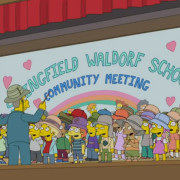
Waldorf Education Featured on The Simpsons Season Finale

The Simpsons gave a well-crafted, comic shout out to Waldorf Education during their Season 26 finale for 2015―“Mathlete’s Feat”, which aired May 17, 2015.

Waldorf-centric Plot Summary

After a scathing math competition defeat, tech bigwigs take pity on Springfield Elementary and outfit the school with all the latest technology. But Principal Skinner’s ineptitude leads to a server farm crash and the school loses all tech, which the students only used to watch Game of Thrones. This is when Lisa comes up with an idea that will save the school―“Learning while Doing.” Springfield Elementary becomes a Waldorf School!

From there the students learn by doing in tongue-in-cheek fashion―calculating the cubic feet of styrofoam to add to the sloppy joe mix, pouring pints of beer in fractions, wearing required sun hats, and singing songs of acceptance, love and diversity. In the end, their new Waldorf Education helps them win the mathlete rematch by transforming an M into nine non-overlapping triangles.

The Association of Waldorf Schools of North America was pleased with the level of in-depth knowledge The Simpsons writers clearly possessed about pedagogy and stereotypes associated with Waldorf Education, which made this fun caricature both lighthearted and flattering.

The Simpsons Writer Insight

Math
Mathematics education is very advanced in Waldorf schools. Math is revealed to students as a useful and real part of everyday life. Numbers, processes and then mathematical concepts are introduced through doing — counting and holding, paper folding, musical interval training, and calculations to create rope and pulley systems are just a few examples of how math is taught in Waldorf schools. We are not surprised that the Springfield Waldorf School could answer such a difficult final math equation to win the math competition. The challenge of drawing the nine non-overlapping triangles mimics the lessons in form drawings taught in our curriculum — another intersection of math, art, and doing experienced in Waldorf Education.

Sun Hats

Why of course! Waldorf students are prepared for all weather, at all times. Why? Because, unlike many of their non-Waldorf peers, they still play outdoors for recess 3-4 times a day and also have classes outdooring such as science, physical education and gardening. Of course, hats for our adults are optional and they’re not required indoors. Nor is tie dye a requirement.

Technology

In the episode, Marge reads a pamphlet which says, “Waldorf Education: When you have Given up on the Modern World.” Considering the popularity of Waldorf Education among the children of Silicon Valley tech executives, this is clearly not quite the case, but it had been a stereotype of the past. Waldorf Educators simply feel there are better ways, more hands on and complex ways to teach young children how to learn. Technology is introduced to secondary education children, which as Skinner notes in the episode is “Not our Problem.”

Textbooks
There are no textbooks in Waldorf Education, it’s true. But there are many, many books. They are just not the ones provided to the state by textbook companies. Instead our students are presented material by teachers from classics and mainstream books on relevant topics, where they then take notes and reflect on lessons while creating their own “Main Lesson” books. These books become both catalogs and resources for learning.

Reflection
We are honored to have been featured in such a positive light on The Simpsons Season Finale and are anxiously awaiting further information about which writers, perhaps Waldorf parents or alumni themselves, were involved in the episode’s creation. As a thank you, and a responding shout out of sorts, our schools have been paying tribute to The Simpsons. A collective of handmade hats is being created to send to The Simpsons writers. The Waldorf School of Philadelphia is having students create beeswax figures of The Simpsons characters to share online and with The Simpsons execs. And the São Paulo, Brazil Waldorf School has done an amazing rendition of The Simpsons Theme Song, found here on YouTube, as a tribute to this mainstream recognition. All social media fun and folly can be tracked with #simpsonslovewaldorf.

Conclusion

Do you have questions about this latest press coverage of Waldorf Education or about Waldorf Education in general? Please contact Mary Eaton Fairfield, Admissions Director, Shining Mountain Waldorf School at: maryf@smwaldorf.org or 303.951.8579.


Wishing a warm welcome to Shining Mountain’s new faculty members

1st Grade Class Teacher

Stacie Schaefer has been hired as our 1st grade Class Teacher to lead the class 1st through 5th grade. She has served as a grades teacher at Waldorf School on the Roaring Fork and as an early childhood teacher at Shepherd Valley Waldorf School. In her early teaching career, prior to meeting Waldorf education, she helped to pioneer the Crestone Charter School, while serving as a grades teacher. Stacie currently operates a Farm/Forest Kindergarten in Niwot.

6th Grade Class Teacher

Michael Janzen has been hired as our 6th grade Class Teacher, and will take the class 6th through 8th grade. He taught grades 4-8 and grade 1 in Taos, New Mexico, before moving to the SMWS community to join our middle school faculty. Michael will complete a 6th-8th grade rotation at Shining Mountain this year, and we are very pleased to have him turn around to take the rising 6th grade class. He currently serves as Chair of the school’s Governance Counsel.

Strings

Emily Anne Bowman has been hired to be our grades 3-12 Strings Teacher. She is a former faculty member at both Shining Mountain and Shepherd Valley Waldorf Schools, and is currently the conductor of the Greater Boulder Youth Orchestra Philharmonic Group, as well as being a faculty member of Boulder Suzuki Strings.

Choir

Cobus DuToit has been hired to be our grades 4-12 Choir Teacher.

High School Humanities

Josh Lytle has been hired to be our High School Humanities Teacher. He is coming to us from the Saratoga Springs Waldorf School, where he has been a High School Humanities Teacher there for over 10 years, and a leader on their faculty.

Reader’s Digest “Faces of America” Features SMWS Teachers

Photographer Glenn Glasser travels across the United States to meet inspiring locals, and 5 SMWS faculty members are featured!